Taas is a collective investment where token is reserved for growth. The channeling back of a given portion of funds for reinvestment boosts growth of the token. The tokenized system is a designed model to curb insecurity and technical barriers. 

Please keep scrolling down and discover the mystery behind TaaS and how it works. 

Today am not ready to beat around the bush. If you are reading this article right now, allow me expose the TaaS {Token-as-a-service}; a transparent business model designed by the Bitcoin group targeting investors of block chain space. 

TaaS-a tokenized close end fund invented to minimize challenges transparency vs technical obstacles in investing in block chain space! 

What is the blockchain?

A transparent and verifiable investment technical model. The collective distributions of database via a transparent system shared by the business partners regulate and verify the recorded information which is articulated within the database. 

Why TaaS?

The new business model is designed and promoted towards many reasons to achieve a certain targeted business spot. The tokenized model is generated to iron the technical barriers vs transparency. 

Taas creates more security for business investments and transaction within the technical system. The system of bitcoin is still a stub system with numerous loopholes hence the creation of this model protects us from exposure to insecurity. 

Profitable Reasons for Creation of Taas Model?

• Inactive regulated market; the bitcoin market is gradually reaching out to every corner of the globe hence the market regulation of the bitcoin mining is gradual in nature. 
• Inadequate investments tools; mining of the bitcoin is generated by online tools designed within a business structure merged with parental tools of business model. 
• Technical huddles; a growing system with booming investments attraction is prone to technical errors since it is still slowly developing. 
• Absence of the market knowledge; the bitcoin investors and associates slowly absorbs the market knowledge of the bitcoin investment. 

How does TaaS works?


• 25% channeled back to investment; the close end fund model operates within a business structure where 25% of the returns are reinvested back to the black chain space for growth of token. 
• Limited to Block chain market; the close end fund is modified and verified with only block chain markets where transparency is highly valued within partnership. 
• 50% quarterly profit sharing; to the shareholders, they are awarded the quarterly profit distribution of 50% as return out of the block chain investment. 
• Reserved fund; around 10% to 30% of portfolio is hedged in bitcoin since the close end fund is a model where shares are limited to internal market. 
• Trusted Transactions; the platforms of trusted transactions are promoted and limited to specific niches such as Bittrex, Kraken, or Poloniex. 

Final remarks

To cut the long story short, let me summarize it up by saying that, TaaS is launched with an eye to watch over technical huddles vs transparency. The close end fund is targeting the block chain market where trusted members transact and share profit via transparent and verifiable system since, the collective distribution of database is open to all partners.


We're launching Waves DEX now, a decentralized solution for digital assets trading. Let's reiterate why we think that it's an important development that can actually change things.

Decentralized blockchain tokens are being traded on very centralized exchanges. Essentially it's a contradiction in terms, that manifests itself in these exchanges being hacked all the time. You just can't trust a centralized service with your decentralized tokens. Bitcoin and other crypto is a perfect thing to steal, transactions are non-reversible, transfers are hard to trace. Centralized cryptocurrency exchanges are not sustainable in the long run, since the cost of an successful attack can ruin any successful exchange.

On the other hand, until we have very high blockchain transactions throughput, we can't have a comfortable solution for a completely decentralized trading. Putting all trading data on the blockchain is doable, but you have to deal with blockchain latency and tons of data which you have to synchronize over all the nodes.

There's a solution in between, and this is the path we have taken — you can do the blockchain settlement but order matching is done in a centralized manner. What does it mean in layman's terms — there's a server which matches incoming orders, but has no access to your funds. There's no chance that you could lose money in this setup, since you have full control over your funds at all times. When the server finds a matching pair it initiates the transfer on the blockchain which moves the funds. The correctness of the matching is verified in a decentralized way, and no funds can be transferred if the orders are not matched properly.

This is a new approach that can be called "Matching as a service". You can mount your own Waves matcher and earn commissions. Probably we don't need to try to decentralize everything at this stage of blockchain protocols development, focusing only on areas where blockchain really improves things considerably. When you need high execution speed centralized solutions work better. Putting the trustless blockchain technology on top you get the best of the two worlds — speed of centralized services combined with blockchain security.

Check Waves DEX out in our lite wallet!

Join Wavesplatform Community on telegram: https://t.me/Wavescommunity

For more information about Waves or to download the client and start trading, visit: www.wavesplatform.com


OpenBazaar, an open-source market that allows buyers and sellers of goods to directly create shops and sell goods without fees, restrictions or accounts, is looking to layer multiple cryptocurrencies into its wallet in the interest of offering lower transaction fees. The online market already allows users to pay for purchases in multiple cryptocurrencies via an integration with the ShapeShift.io exchange.

With rising bitcoin fees, Mike Wolf, design lead at OpenBazaar, has proposed supporting multiple cryptocurrencies, noting there are details to be worked out.

"Bitcoin fees are getting high," Wolf tweeted. "Should @OpenBazaar support multiple cryptocurrencies?" The tweet directed readers to a Youtube video in which he presented an idea for how multiple currencies could layer into the OpenBazaar wallet.

"We have not thought about all of the functional aspects of it yet," Wolf said in the video. The team is looking for feedback as to whether the concept has value. "Let us know what coins you think are most useful," he said. "We'll definitely read through them."

Wolf also posted a survey on Twitter asking people to vote on whether OpenBazaar should support multiple currencies. With 443 votes cast and six days left, 87% wanted to see OpenBazaar accept multiple currencies.

"Relying 100% on bitcoin might not be realistic in the near future," Wolf said. "From the Open Bazaar perspective, we really want to keep fees as low as possible."

BOScoin is a new virtual currency created by the South Korean Fintech startup BlockChain OS. According to regional publication Pulse News, like existing virtual currencies, the new digital currency is also based on a blockchain. However, according to the Seoul-based company, the difference consists in the blockchain's ability to allow higher transaction speeds. BOScoin transaction speeds will reach up to 1000 transactions per second, in line with credit card processing speeds. 

BlockchainOS has presented the concept of the BOScoin platform at meetups in London and Berlin/ The Foundation has been answering questions from the wider community on a wide range of interest areas including design, architecture, technical, operations applications, and governance. 

BOScoin is designed as a platform for a self-evolving crypto currency, an improved version of other popular virtual currencies such as Ethereum and Bitcoin. BOScoin was developed to work with Trust Contracts that provide an approachable and decidable and framework for creating and executing blockchain contracts. 

The decision making body for the new BOScoin digital currency is the Congress Network. Congress members have the right to decide on what proposals are eligible for Commons Budgets. They also have the right to decide the functions of the blockchain itself and the revision of the policies. The Congress Network aims to create a more productive and democratic decision making process. With its particular policy rules, BOScoin is expected to avoid the hard-forking and community separation of blockchain. 


The official ICO invites the general public to participate in this international crypto currency platform. The pre-ICO funding has already raised US$3 million. According to a report from Korean publication DataNet, all code and tools used by the South Korean developers of BOScoin will be released as open-source. A next-generation smart contract solution powers BOScoin. The system is bases on an "inference engine". 

The creators of BOScoin hope to overcome the operational and technical issues present in many other crypto currencies. While deterring the centralization of power, the issuance plan and the incentive scheme of the BOScoin cryptocurrency platform aims to create value for the coin. While being more energy efficient, low latency BOScoin transactions will be created with the help of the Modified Federated Byzantine Agreement algorithm. 

A user or a machine is helped to decipher the contract by this core code and software engine. This approach is opposed to existing smart contracts that are currently written in program-level code. For most users, these existing smart contracts may prove difficult to understand. The South Korean developers of the BOScoin appear to aim, essentially, for a more-straightforward blockchain. 

The BlockchainOS Foundation that issue and manage the token currency BOScoin is established in Switzerland. BlockchainOS has engaged EY's Asia-Pacific data and analytics capability called EYC3 in its efforts to support development of the BOScoin cryptocurrency. EY has a global experience in cryptocurrency and blockchain, reaching a footprint across 150 countries. The strategy behind the new BOScoin digital currency platform is taking advantage of the critical leading data and analytics capabilities of EYC3. 

By utilizing their governance expertise, as well as their wide range of experience in working with private global companies, EY will be able to apply their known how to supporting the BOScoin platform's self-evolving governance system. The platform provides the foundations for a secure system where even non-technical users can create sharable and immutable blockchain contracts. 


Large companies dominating the industry may think we're crazy; we think what we're doing is just right.

Let's start by getting the obvious out of the way; building a self-governed P2P marketplace is a complete paradigm shift. Today, shopping online requires three or more entities to be involved just to complete a sale. That's crazy! The market leaders have been perfecting customer retention, personalized recommendations and last minute deals for over two decades now. Online shopping has become so refined that buyers and sellers hardly even talk unless a problem arises, but at what cost?

Predicting what customers would like to buy isn't just a lucky guess; it's largely based on their personal shopping and browsing history. Customer metadata is collected, harvested and applied to algorithms built to maximize the bottom line. It may seem pretty cool and handy from the outside but the truth is that it is a trust-based system in which the customer usually has no choice but to accept in order to shop online. This trust extends all the way to each company's infrastructure (servers) and their ability to protect your personal data from bad actors. One could argue, "Doesn't this turn Me into the product?"

So why reinvent an entire industry that has perfected a good, logical and profit-generating business model that appears to have the customers' best interest in mind? Simple! Choice. At this time, every eCommerce platform is essentially the same. There is at least 1 payment processor who needs to be involved, collect data and charge a fee. Depending on the platform, there is at least 1 more company involved with listing the item, collecting data and charging a fee. Anytime you are not in control of your personal data and/or money, you run a huge risk of that information being manipulated, misused or hacked by a third-party. The latter can lead to embarrassing or precarious situations, for example the huge Ashley Madison leak.

Particl has a place in this industry and the time for us is now!

What is Particl?

This is a hard question to answer at first take. 

"Hey, look everyone, here's a startup now taking on many Goliaths." Amazon and eBay have 20+ years head start on the team and multiple-times over many more resources. This is a battle every startup faces and history has shown that the public responds well when what you're doing is the right way to do it.

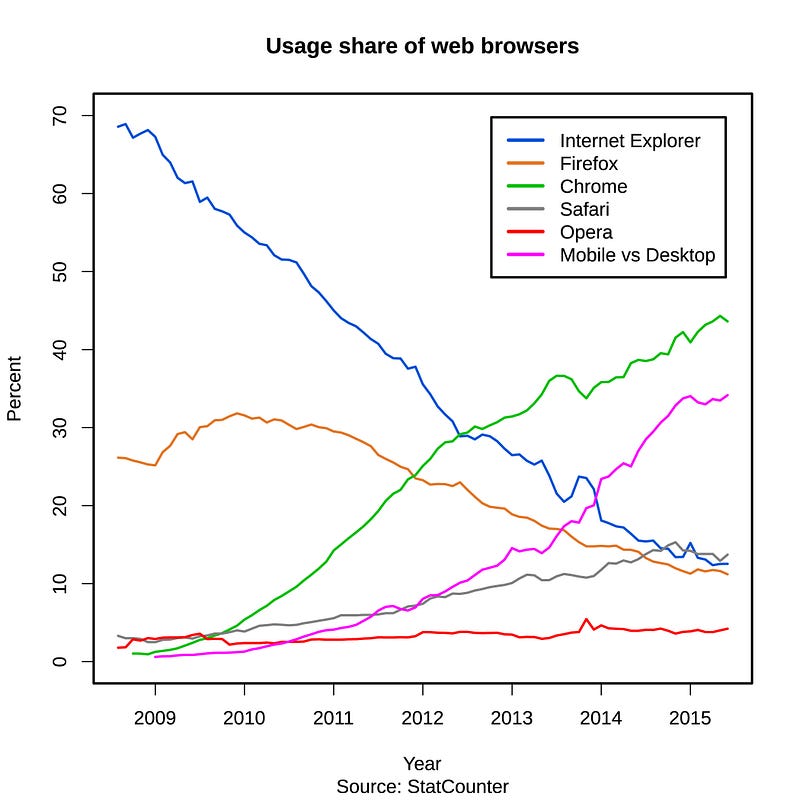
By Usage share of web browsers (Source Net Applications).svg: arichnad, Daniel.Cardenas, Litehacker — Own work, CC BY 3.0, https://commons.wikimedia.org/w/index.php?curid=15824338

Market Analytics

The best companies in the eCommerce sector have gotten to the top through stellar market analytics. However, these are only valuable to centralized companies. Strong market analytics are necessary to continually grow revenue and profits. Particl is a decentralized platform that barely collects fees to list or transact. We'll never be a bloated company with outrageous executive payrolls or lucrative stock options. The team is lean and focused on research and development in an open source environment. All fees generated on the platform are automatically redirected to the community of people keeping the network secure by running nodes and staking.

Product Recommendations

Another aspect of market analytics linked to customer retention is personalized recommendations. These added "features" rely 100% on user metadata. On Particl there is absolutely no way to collect user metadata for recommendations since everything is encrypted. Only the buyer and seller know that a transaction has ever taken place. On the public ledger, it reads like any other generic transaction. Anything from both the buyer and seller's data, the purchase history, the terms of a sale, and more are encrypted and private. We take metadata leakage very seriously, which adds a level of complexity to this project that traditional eCommerce platforms don't have to deal with.

Particl's overall competitiveness to mainstream marketplaces will take time and that's okay. Not only are we providing tools that give people a choice in an otherwise black and white 20+ year old industry, but we are also extending a helping hand to those who never did have such a choice.

Particl does offer benefits even the biggest industry leaders can't offer at this time and that is a positive way to start our journey. On top of working in an open source environment the project also offers:

  • passive income for users operating nodes and helping to secure the network.
  • zero-to-low fees
  • freedom to list almost anything
  • ownership of the platform through self-governance
  • private listings
  • 2 party trustless (MAD) escrow — whitepaper
  • end-to-end encrypted communication

Why not build Particl on Ethereum?

This is a valid question and one that would be more applicable if we were building Particl from scratch. The MVP prototype was built on Bitcoin code along with upgrades and innovations from the Shadowcash code. The Bitcoin codebase isn't causing any issue or roadblock to the development of the platform and our upgrade to the latest bitcoin codebase is only going to enhance the performance and security of Particl, as well as add a bunch of new features. I appreciate Ryan X Charles' point of view when discussing jumping ship versus solving problems. While the protocol may be more advanced than Bitcoin, moving to Ethereum would produce additional problems to solve and slow the progress on bringing the Particl platform to market. For example: Ethereum still runs on a PoW consensus algorithm while Particl runs on PoS consensus, which is a value added feature to our network ownership, governance and reward structure.


Video Particl

https://www.youtube.com/watch?v=yQvFUYrdDJU


Reports are emerging that an agent for an Indian law enforcement agency has been arrested for stealing bitcoins tied to a drug bust.

According to the Times of India, an officer for the Indian Narcotics Control Bureau (NCB) is alleged to helped steal more than 400 bitcoins originally confiscated during a 2015 seizure. Specifically, investigator Satyendra Kumar Singh is said to have been accused of unfreezing those funds at the behest of one of those arrested.

The media source claimed that it was the first such case in India – though the cryptocurrency world is no stranger to rogue agents siphoning bitcoins obtained during criminal investigations.

The NCB reportedly alleged that Singh consulted with Deepak Manguikya, one of the accused drug dealers, after he was released on bail in 2016. In July 2016, Singh then helped Manguikya forge documents which would allow for the unfreezing of the accounts where the bitcoins were stored. After being unfrozen, the accounts were emptied and liquidated with Singh allegedly receiving 50% of the proceeds.

Officials noticed the missing coins while working on a report regarding the status of the seized funds. Subsequently, the NCB moved to suspend and arrest Singh, and an investigation into his role in the heist is said to be ongoing.


Count yourself lucky if you are reading it right now. Lunyr is a platform which is gradually promoted with an octane team of experts - for next generation decentralized applications with artificial intelligence, virtual reality and augmented reality. 

Lunyr is an open source base of information which is blockchain based. 

Lunyr is a future oriented API; an open source platform for application developers is based on capturing authentic information of the reality world by offering LUN- to attract peer reviewing and pure information contribution on this platform by users. 

What is LUN?

LUN is also known as Lunyr tokens. This is a very astounding concept for the anonymous. The LUN concept articulates around a business model where Lunyr tokens are granted applicable mandate for ads. 

The Lunyr tokens are aimed to be endorsed to the users of this platform as their rewards for their honest review and information contribution to enable Lunyr attracts more traffic. 

Lunyr Business Structure

A cleverly designed business program blockchain based. The open source computing system is Ethereum oriented to crowdsource genuine information of reality world to develop its API {app program interface} to create artificial intelligence, argumented reality and virtual reality. 

The decentralized crowdsourced information works on next generation decentralized applications. The creation of decentralized applications need reality world information hence Lunyr has designed a model to attract reality global on this information. 

The platform target ads business. The set protocols' of the platform is to attract high rise visiting audience like for example the Wiki platform so as to generate revenue from the ads since ads are purchased by using LUN{Lunyr tokens}. 

LUN follows ERC20 token standard! 

Lunyr Long Term Vision

Augmented Reality: a knowledge bank platform where all your curiosities are answered by just a tap of the knowledge base. The Lunyr platform API is developed with a decentralized distribution of Ethereum based crowdsourced information which generates augmented reality. 

Virtual Reality; visceral vs. intimate is an experience generated and articulated by the decentralized applications based on factual information base. The Lunyr API is decentralized to design and paint the picture in your head anytime a user source a given virtual reality. Artificial intelligence; an art of designing a platform where the applications program interface are decentralized in nature with a global reality crowdsource information. Lunyr model is geared in the same league of amazon where reality, accurate and facts are gathered and reviewed so as to feed the users with meaningful information. 

Lunyr Team


The Lunyr platform is created and supported by a solid team of common interest. The team is composed by a chain of different expertise ranging from technical administrators, successful advisors and serial investors working down and up to ensure growth and development of Lunyr prosper. 

Final remarks

Let us cut to the chase and summarize it up by saying, Lunyr platform is a factual information bank targeting marketing audience. The API is decentralized with decentralized distribution of deeply crowdsourced and reviewed information to attract purchase of ads by using LUN. 

However, by rewarding LUN for your reviews and information contribution, is aimed at creating next generation decentralized applications. The long term vision is manifested in achieving virtual reality, augmented reality and artificial intelligence. 

Join the ICO!

@ Lunyr.com 

Visit the Lunyr.com website